
Your Content Is Somebody's Training Data
When you publish a blog post, a product page, or a landing page — you're not just writing for your audience. AI companies are watching too.
Crawlers operated by OpenAI, Anthropic, Google DeepMind, and dozens of smaller AI labs systematically scrape the public web to collect training data for large language models. Your original writing, your product descriptions, your pricing pages — all of it ends up in datasets used to train AI systems that compete with the businesses that created that content.
How AI Crawlers Work
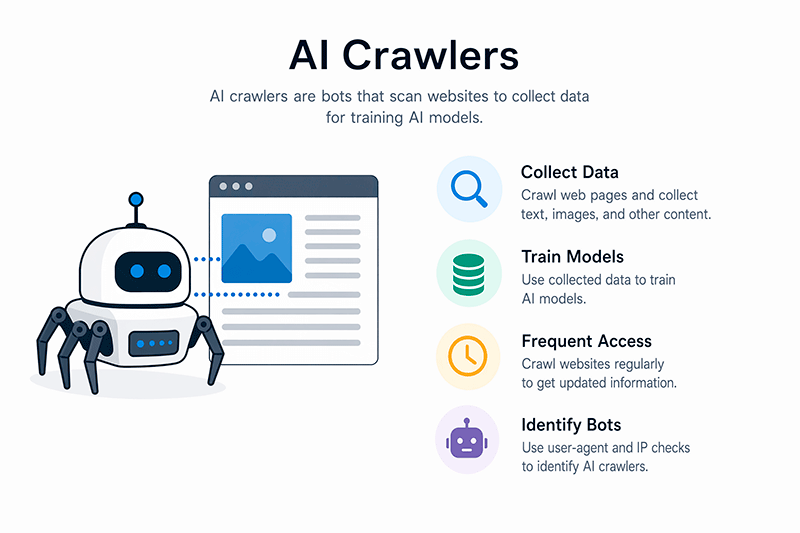
AI crawlers behave a lot like search engine bots, but with a different purpose:
- They discover URLs through sitemaps, backlinks, and prior crawls
- They fetch page content, stripping HTML to extract raw text
- They store and process that text as training data
- They return on a schedule to collect updates
Many operate under known user-agent strings like GPTBot, ClaudeBot, Google-Extended, or CCBot. But increasingly, operators use disguised or rotating user agents that look like regular browsers — making naive blocklists ineffective.
The Real-World Impact
- Content devaluation — your unique content gets absorbed into AI knowledge bases and regurgitated to users who never visit your site
- Competitive exposure — pricing pages, campaign structures, and sales copy can be extracted and analyzed by competitors via AI tools
- SEO cannibalization — AI-generated summaries reduce click-through rates from search, even when you rank #1
Why robots.txt Isn't Enough
Many site owners add entries like Disallow: / for known AI bot user agents to their robots.txt. This works for compliant crawlers — but:
- Compliance is voluntary
- Disguised crawlers ignore it entirely
- There's no enforcement mechanism
Blocking at the request level — before content is served — is the only reliable method.
How BlockBots Handles AI Crawlers
BlockBots maintains an up-to-date intelligence database of known AI crawler IPs, ASN ranges, and behavioral signatures. When a request matches a known AI crawler — or behaves like one — it's blocked before your page content is served.
✔ Block named AI crawlers (GPTBot, ClaudeBot, CCBot, etc.)
✔ Detect disguised crawlers via behavioral analysis
✔ Allow legitimate search engines (Google, Bing) by default
✔ Zero impact on real user experience or SEO